
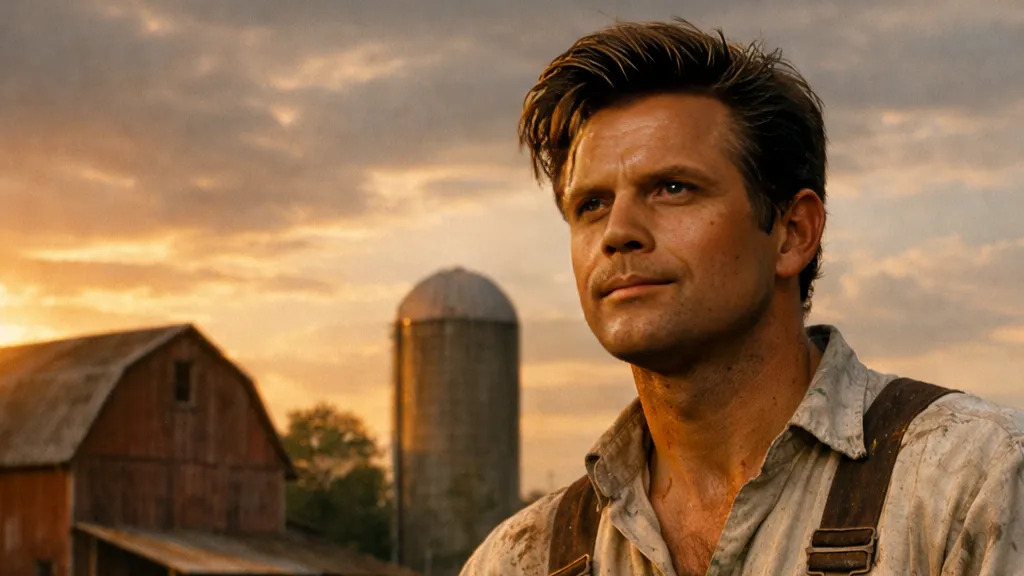
Long before he became one of television's most iconic detectives, Jack Lord was simply John Joseph Patrick Ryan—a farm boy from rural New York with paint-stained hands and big dreams. His journey from those wide-open fields to the bright lights of Broadway wasn't a straight path or an easy one. It was forged through hard work, sacrifice, and an unwavering belief in himself when no one else did. Understanding Jack Lord's early years reveals not just how he became a star, but why he became the kind of man who would eventually give everything away.
The Farm Boy Foundation
Jack Lord—born John Joseph Patrick Ryan in 1920—didn't start life with Hollywood dreams or silver-screen ambitions. His earliest memories were of wide-open spaces, the rhythmic sound of hoofbeats, and the smell of fresh paint on canvas. Growing up on his mother's farm in rural New York, young Jack spent his days riding horses across rolling fields, developing a deep connection to animals and the natural world that would stay with him throughout his life.
Those formative years on the farm instilled something essential in Jack's character: a work ethic forged in early mornings and physical labor, a respect for simplicity, and an appreciation for beauty in everyday moments. He would spend hours painting the landscapes around him, capturing the play of light across fields and the changing seasons in watercolors and oils. Art wasn't just a hobby—it was how he learned to see the world, to observe details, to tell stories without words.
His summers took him in a completely different direction: to the sea. These maritime experiences weren't casual vacations but formative adventures that shaped his understanding of discipline, navigation, and the vastness of the world beyond rural New York. This dual upbringing—grounded in earth and drawn to water—created a young man comfortable with contrasts, someone who could appreciate both stability and adventure.
Education and the Merchant Marine
When it came time for higher education, Jack chose the U.S. Merchant Marine Academy, graduating as an Ensign. The Academy demanded precision, leadership, and an ability to perform under pressure—qualities that would serve him well in the competitive entertainment industry. But Jack's interests remained broader than a single career path. He pursued a Fine Arts degree at New York University, earning a football scholarship that made the education financially possible. Here was a young man who could excel on the athletic field, in the art studio, and in the classroom—a Renaissance figure in the making.
The Car Salesman Who Dreamed of the Stage
Yet the path from rural farm boy to working actor wasn't straightforward or glamorous. After graduation, Jack took a job as a car salesman—not because he loved automobiles, but because he needed to fund his real passion: acting classes. Picture this determined young man spending his days convincing customers to buy Chevrolets and Fords, then rushing to evening acting workshops where he could finally pursue what truly called to him. It was a humbling apprenticeship, one that taught him the value of persistence, the reality of rejection, and the importance of believing in yourself when no one else does.
These early struggles shaped Jack Lord's character in ways that wealth and fame never could. He understood what it meant to work for something, to sacrifice comfort for passion, to bet on yourself when the odds weren't favorable. The values instilled on that New York farm—hard work, integrity, commitment—would guide every decision he made, from his approach to acting to his eventual philanthropic vision.
Broadway Breakthrough
By the early 1950s, Jack Lord's persistence was paying off. He landed roles on Broadway, that most demanding and prestigious of American stages, where actors prove themselves night after night before live audiences who can sense any false note or lazy performance. In 1954, he appeared in The Traveling Lady, followed by a role in Tennessee Williams' Cat on a Hot Tin Roof in 1955—one of the most celebrated plays of the American theater canon.
Broadway in the 1950s was intensely competitive. Hundreds of talented actors competed for every role, and the theater world could be unforgiving to those who didn't measure up. What made Jack Lord stand out wasn't just his striking looks or commanding presence—though he had both—but his complete commitment to his craft. He brought the same discipline he'd learned at the Merchant Marine Academy and the same attention to detail he'd developed as a painter. Every gesture mattered. Every line reading was considered. He approached acting not as pretending but as truth-telling.
The Foundation of Character
Jack Lord's journey from farm boy to Broadway star wasn't just about acquiring skills or making connections—it was about building character. The young man who rode horses across his mother's farm learned patience and respect for living things. The merchant marine learned discipline and leadership. The car salesman learned humility and persistence. The painter learned to see beauty and tell stories. The Broadway actor learned to deliver truth under pressure.
These weren't separate chapters in Jack Lord's life—they were layers of foundation, each one essential to what he would build. When success finally came, he would remember what it felt like to struggle. When wealth accumulated, he would remember the value of hard work. And when it came time to decide what to do with everything he'd earned, he would remember that the best things in life—beauty, purpose, meaning—can't be bought or inherited. They have to be created, nurtured, and shared.
The farm boy who became a Broadway star was learning lessons that would matter far more than any role he'd ever play. He was learning how to be a man worth remembering.
501 Donate connects donors with thoroughly vetted charities and causes that matter. For questions, reach us through our YouTube channel, website, or email—or contact the 501(c)(3) organization directly. Please note that 501 Donate is a for-profit marketing company, not itself a nonprofit or charity, and does not accept donations or gifts of any kind.