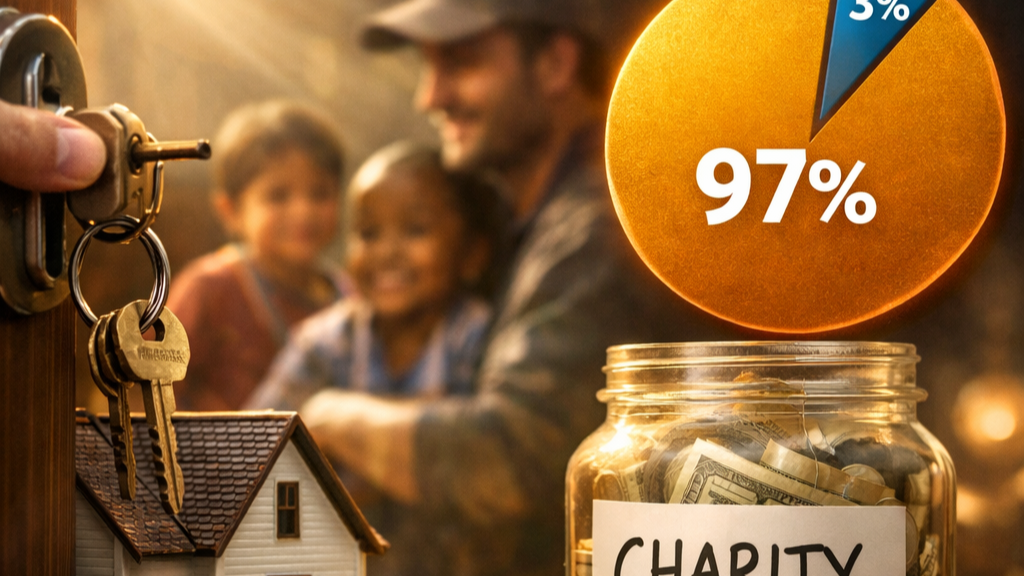
Depending upon who you know and where you live in the U.S., you may or may not be surprised to learn that religious causes are the single biggest category of donation recipients by far, accepting 28% of charitable donations made in the year 2020. Education and human services aren't far behind, accounting for a total of 29% of philanthropic dollars. These are worthy causes, certainly—no one would argue otherwise. But here's what should shock us: the environment and animal welfare combined receive just 3% of Americans' overall charitable gifts. Three percent. For the systems that sustain all life on Earth, we allocate less than we spend on coffee in a month. While we pour resources into institutions that serve humanity today, we're systematically defunding the future that makes any of those institutions possible.
This isn't about pitting causes against each other. It's about recognizing a catastrophic blind spot in our collective priorities. We're meticulously arranging deck chairs while ignoring the hull breach below the waterline.
But if we don't have a livable planet, there won't be anyone left to help. The climate crisis isn't a distant threat anymore—it's the emergency unfolding outside our windows right now. Climate scientists estimate we could be as close as seven years away from the "point of no return," the threshold beyond which certain feedback loops become irreversible and catastrophic warming becomes inevitable. Seven years. That's less time than it takes to put a child through elementary school.
And we're already living through the preview. Remember the Texas winter storm of 2021? Temperatures plummeted to levels the state's infrastructure was never designed to handle, leaving millions without power, heat, or water. At least 246 people died—freezing in their homes, succumbing to carbon monoxide poisoning from desperate attempts to stay warm, or losing access to medical care. This wasn't a freak accident; it was a direct consequence of destabilized climate patterns. Across the United States, communities are already grappling with what were once considered worst-case scenarios: prolonged droughts that drain reservoirs, wildfires that consume entire towns in hours, hurricanes that intensify with terrifying speed. There are regions where securing clean drinking water is no longer a given, where summer heat makes outdoor work life-threatening, where "hundred-year floods" now arrive every few years. Without drastic action, these aren't anomalies—they're the new baseline. And it only escalates from here.
The lack of perceived urgency is itself a crisis. For much of American history, environmentalism wasn't a partisan battlefield—it was a shared value rooted in cultural appreciation for the natural beauty of the continent. Theodore Roosevelt, a Republican president, established the U.S. Forest Service, created five national parks, and protected approximately 230 million acres of public land. Conservation was seen as fundamentally American, a matter of preserving the nation's heritage and resources for future generations. Democrats and Republicans alike understood that protecting the land wasn't radical—it was common sense.
That consensus shattered in the 1980s. When environmental protections began to clash with the Reagan administration's ideology of extreme, deregulated capitalism, conservation transformed from a bipartisan priority into a political wedge issue. Suddenly, caring about clean air and water was coded as liberal. Protecting endangered species became an attack on business. Climate science was reframed as partisan rather than empirical. This shift didn't happen because the science changed or because the land became less valuable—it happened because powerful economic interests found it profitable to manufacture division. And we've been paying the price ever since, locked in ideological battles while the planet's life-support systems deteriorate.
We need to reverse this—not by returning to a romanticized past where Americans loved their land for chiefly aesthetic reasons, but by recognizing that we're all ultimately on the same side here. There is no version of the future where some of us escape the consequences while others suffer them. The atmosphere doesn't recognize state borders or political affiliations.
And right now, the people suffering most aren't the ones who created this crisis. Climate change is disproportionately devastating marginalized communities—the populations with the least resources to adapt, relocate, or rebuild. Low-income neighborhoods are more likely to lack tree cover, making them urban heat islands where temperatures soar dangerously higher than in wealthier areas just miles away. Communities of color are more likely to live near industrial pollution sources, compounding respiratory vulnerabilities as air quality worsens. Indigenous peoples, whose lands are being stripped and flooded, are losing not just homes but entire ways of life that have endured for millennia. Farmworkers, many of them immigrants, labor in fields where heat exposure is becoming lethal, with little recourse or protection.
This is more than enough reason to act swiftly and decisively. If we care about justice, if we claim to value human dignity and equity, then treating climate action as optional is moral bankruptcy. Every day we delay, we're making a choice about who deserves to survive and who we're willing to sacrifice. The communities on the front lines of this crisis didn't cause it, but they're being asked to pay the highest price. That should be intolerable to anyone with a conscience.
But even for those who are concerned only with their own self-interest, the math is simple: wildfires don't check your income bracket before they burn your neighborhood, and no amount of wealth will protect you when food systems collapse or when your city runs out of water. The 3% we currently allocate to environmental causes isn't just inadequate—it's a civilization-scale miscalculation that treats our only planet as an afterthought. We can fund every worthy cause in the world, but none of it will matter if we're fighting over the last habitable zip codes.
At 501 Donate, we connect donors with thoroughly vetted charities and causes that matter. For questions, you can reach us through our YouTube channel, website, or email— or contact the 501(c)(3) organization directly. As a for-profit marketing company, our sole focus is bridging the gap between donors and the nonprofits they care about, with guidance every step of the way. Please note that 501 Donate is not itself a 501(c)(3), a nonprofit, or a charity, and does not accept donations or gifts of any kind.