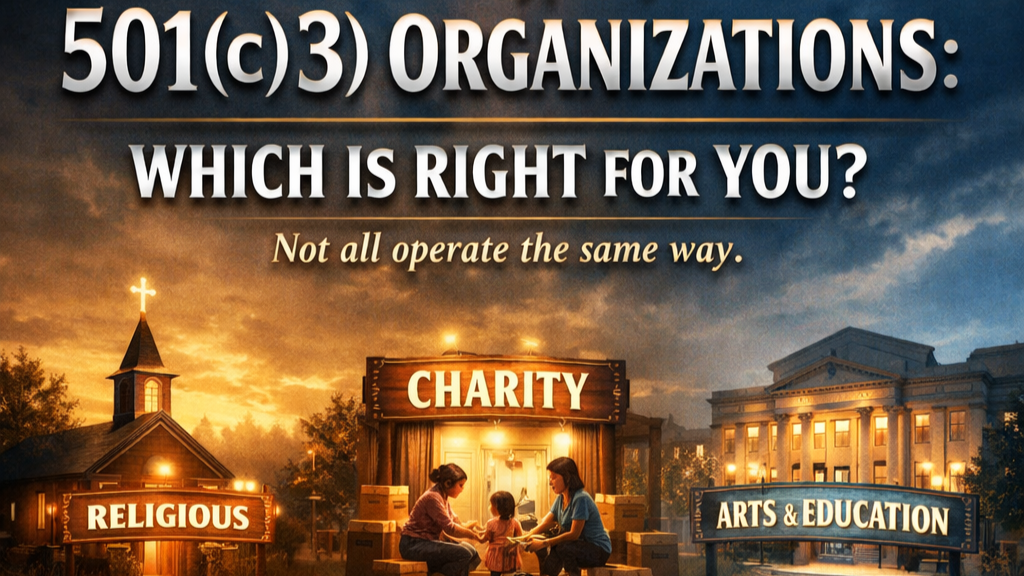
Not all 501(c)(3) organizations operate the same way. The structure you choose will affect your governance requirements, funding sources, donor tax benefits, and regulatory obligations. Understanding these differences is crucial for selecting the right structure for your mission.
Public Charities
Not all 501(c)(3) organizations operate the same way. The IRS recognizes three distinct structures, each with different characteristics, requirements, and benefits.
Public charities are what most people envision when they think of nonprofits—organizations with active programs serving communities. Examples include churches, food banks, homeless shelters, animal welfare agencies, schools, and hospitals.
Key Characteristics:
Active programs: Public charities directly conduct charitable activities rather than just funding other organizations
Broad public support: Must receive at least one-third of donated revenue from a fairly broad base of public support, including individuals, companies, government grants, or other public charities
Independent governance: The governing board must be composed mostly of independent, unrelated individuals (not related by blood, marriage, or outside business connections)
Higher donor deduction limits: Individual donors can deduct contributions up to 60% of their adjusted gross income (though other tax circumstances may affect this). Corporate donors generally face a 10% limit
Public Support Test:
To maintain public charity status (and avoid reclassification as a private foundation), organizations must pass an annual public support test. This typically means demonstrating that at least one-third of total support comes from qualifying public sources. Organizations that fail this test may be reclassified as private foundations, which carry additional restrictions and reporting requirements.
Private Foundations
Private foundations, often called "non-operating foundations," typically don't run active charitable programs. Instead, they support the work of public charities through grants, though some engage in direct charitable activities.
Key Characteristics:
Limited public support requirement: Not required to demonstrate broad public support; may be funded by a single individual, family, or small group of donors
Grant-making focus: Most private foundations primarily make grants to public charities rather than operating programs directly
Closely held governance: Can be controlled by a family or small group; no requirement for independent board members
Lower donor deduction limits: Individual donors can deduct contributions up to 30% of adjusted gross income
Additional regulations: Subject to excise taxes on investment income and strict rules about self-dealing, excess business holdings, and required annual distributions
Common Example:
Family foundations are the most recognizable type of private foundations. A wealthy family might establish a foundation, fund it with a significant donation, and then make grants to various public charities over time while maintaining family control of the foundation's governance and grant-making decisions.
Private Operating Foundations
Private operating foundations are the least common 501(c)(3) structure. The IRS defines them as "private foundations that devote most of their resources to the active conduct of their exempt activities."
Key Characteristics:
Hybrid structure: Combines active programs (like public charities) with potentially close governance (like private foundations)
Active program requirement: Must spend at least 85% of adjusted net income or minimum investment return (whichever is less) directly on active charitable programs
Moderate donor deduction limits: Individual donors can deduct contributions up to 50% of adjusted gross income
Foundation regulations apply: Subject to many of the same restrictions as private foundations, including excise taxes and self-dealing prohibitions
Common Examples:
Museums, libraries, and research institutions sometimes operate as private operating foundations, particularly when they're funded by a single source but conduct active educational or research programs.
Choosing the Right Structure
Most new charitable organizations become public charities because this structure offers:
The highest donor deduction limits (encouraging larger donations)
Fewer regulatory burdens than foundations
Greater public credibility
No excise taxes on investment income
However, private foundations make sense when:
A single donor or family wants to maintain control
The primary purpose is grant-making rather than direct service
The organization has significant endowment funds to invest
Private operating foundations are appropriate only in specific circumstances where an organization operates active programs but doesn't meet public support requirements or prefers foundation-style governance.
Each 501(c)(3) structure offers distinct advantages depending on your mission, funding sources, and governance preferences. Most organizations pursuing active charitable programs will find that public charity status best serves their needs, but private foundations and private operating foundations fill important niches in the nonprofit sector.
501 Donate connects donors with thoroughly vetted charities and causes that matter. For questions, reach us through our YouTube channel, website, or email—or contact the 501(c)(3) organization directly. Please note that 501 Donate is a for-profit marketing company, not itself a nonprofit or charity, and does not accept donations or gifts of any kind.