
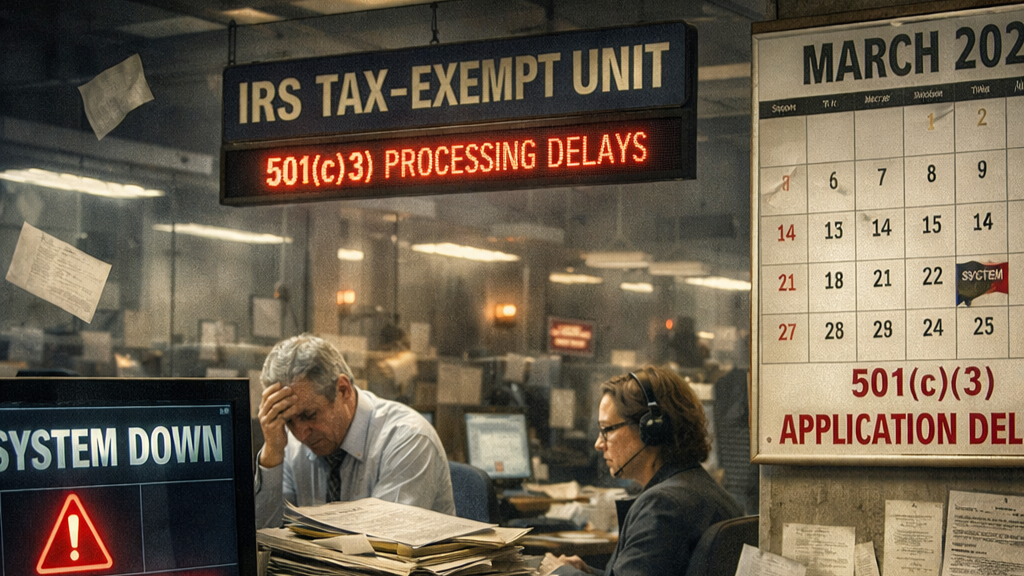
Since mid-March 2025, the IRS's internal operating system for processing tax-exempt status applications has been down, creating significant delays for new organizations seeking 501(c)(3) status. This article explains what's happening, why it matters, and what nonprofit applicants should do.
The IRS System Outage: What Happened?
The IRS's internal operating system for exemption applications has been down since mid-March 2025, creating an unprecedented backlog for organizations seeking tax-exempt status.
The System Responsible for Processing Applications
The IRS uses a specialized internal system to process tax-exempt status applications and issue determination letters:
Application intake and assignment to IRS reviewers
Review and analysis of application materials
Communication with applicants about questions or deficiencies
Approval decisions and determination letter generation
Database updates reflecting new tax-exempt organizations
This system is critical infrastructure for the entire tax-exempt application process.
What "Down" Means
The system outage has specific implications for the application process:
Applications are still being accepted by the IRS
Applications are being reviewed by IRS staff
Approval decisions are being made for qualifying organizations
Determination letters cannot be issued due to system limitations
No timeline has been announced for system restoration
This means organizations are in limbo—approved but unable to receive official confirmation of their tax-exempt status.
Applications Affected
The outage affects all types of tax-exempt status applications:
Form 1023 — Application for Recognition of Exemption Under Section 501(c)(3)
Standard application for charitable organizations
Most common form for nonprofits seeking tax-exempt status
Typically takes 2-4 months to process under normal circumstances
Form 1024 — Application for Recognition of Exemption Under Section 501(c)(4)
Application for social welfare organizations
Used by advocacy and civic organizations
Typically takes 4-6 weeks to process
Form 1024-A — Application for Recognition of Exemption Under Section 501(n)
Application for charitable risk pools
Less common but still affected by outage
Processing times vary
All other tax-exempt status application forms for various 501(c) categories are similarly affected.
Current Status and IRS Response
The IRS has acknowledged the system outage but provided limited information:
The IRS is working to resolve system issues but has not provided technical details
No restoration date has been announced or estimated
The IRS continues to accept applications despite the processing backlog
Limited communication has been provided to affected applicants
No alternative process has been established for issuing determination letters
This lack of information creates significant uncertainty for organizations awaiting tax-exempt status.
Why This Matters: Implications for Your Organization
The inability to receive a determination letter creates serious operational and financial challenges for new nonprofits.
No Tax-Deductible Donation Eligibility
Without a determination letter, organizations cannot offer donors tax-deductible contributions:
Individual donors cannot claim tax deductions for their contributions
This significantly reduces fundraising effectiveness as many donors prioritize tax benefits
Major donors may delay giving until tax-exempt status is confirmed
Foundation grants may be unavailable as many require proof of tax-exempt status
Corporate giving programs typically require determination letters
The inability to offer tax-deductible contributions is perhaps the most significant operational impact of the system outage.
No Federal Tax Exemption
Organizations cannot benefit from exemption from federal corporate income tax:
Organizations must file corporate tax returns and pay taxes on net income
This creates unexpected tax liability and compliance costs
Financial projections are disrupted by unanticipated tax obligations
Cash flow is impacted by tax payments
Accounting complexity increases with tax filing requirements
While many new nonprofits have minimal net income, the tax filing requirements create administrative burden.
No State Tax Exemption
Many states require a federal determination letter to grant state tax exemptions:
State income tax exemption may be unavailable without federal determination
State sales tax exemption often requires federal determination letter
Property tax exemption may be delayed or denied
State charitable solicitation registration may be complicated
State grant eligibility may require federal tax-exempt status
The inability to obtain state tax exemptions compounds the financial impact of the federal system outage.
Loan and Grant Ineligibility
Many lenders and Grantmakers require a determination letter before providing funds:
Bank loans for nonprofits typically require proof of tax-exempt status
Foundation grants almost universally require determination letters
Government grants at state and local levels may require federal status
Corporate giving programs typically have determination letter requirements
Fiscal sponsorship arrangements may be the only option for receiving grants
This ineligibility severely limits organizations' ability to secure necessary funding.
Operational Uncertainty
New organizations face extended uncertainty about their final tax status:
Strategic planning is complicated by uncertain tax status
Board and staff morale may be affected by prolonged uncertainty
Donor confidence may be undermined by inability to confirm status
Partnership opportunities may be limited without confirmed status
Long-term sustainability is questioned when basic status is unresolved
This uncertainty affects not just finances but organizational culture and stakeholder confidence.
Timeline for Tax-Exempt Status Before Outage
Understanding normal processing times helps organizations assess the impact of current delays.
Form 1023 Processing Times
Under normal circumstances, Form 1023 applications are processed on the following timeline:
Expedited Processing (2-4 weeks):
Available for organizations with urgent need
Requires additional fee
Limited to specific circumstances
Not guaranteed even when requested
Standard Processing (2-4 months):
Most common processing timeline
Varies based on application complexity
May be longer if IRS requests additional information
Includes time for IRS review and determination letter issuance
Form 1024 Processing Times
Form 1024 applications typically process faster:
Standard Processing (4-6 weeks):
Faster than Form 1023 due to different requirements
Still subject to delays if additional information needed
Includes determination letter issuance
Complex Applications
Some applications take significantly longer:
6+ months for complex cases:
Organizations with unusual structures or activities
Applications requiring extensive IRS review
Cases involving novel legal questions
Applications with significant deficiencies requiring multiple rounds of correspondence
Impact of Outage
With the outage, add significant additional time:
Applicants approved before mid-March have not received determination letters
New applications cannot receive timely determination letters until system restoration
The backlog will take time to clear even after system restoration
Organizations should plan for delays of 3-6+ months beyond normal processing times
What Applicants Should Do Now
Organizations affected by the outage should take proactive steps to manage the situation.
Check Your Application Status
1. Visit the IRS website regularly to check application processing status
The IRS Tax Exempt Organization Search tool provides some information
The IRS website indicates the date of applications currently being assigned to reviewers
This helps estimate when your application might be reviewed
Check weekly updates
2. The IRS shares the date of submission of applications it is currently assigning to reviewers
This information is updated periodically on the IRS website
Compare this date to your submission date to estimate your place in queue
Understand that review does not mean determination letter issuance
3. This will help you estimate when your application might be approved
Though determination letters cannot yet be issued
Knowing your application is under review provides some certainty
You can plan operations based on estimated approval timeline
4. Contact the IRS directly if your application has been pending for an unusually long time
Call the IRS Tax Exempt Organizations phone line
Be prepared for long wait times
Have your application information ready
Ask specific questions about your application status
Prepare for Extended Timelines
1. Plan for determination letters to take significantly longer than normal
Add 3-6+ months to normal processing times
Build this into your operational and financial planning
Communicate realistic timelines to stakeholders
Don't make commitments based on optimistic timelines
2. Prepare contingency plans for operations during the period without a determination letter
Develop alternative fundraising strategies that don't depend on tax-deductibility
Consider interim organizational structures
Plan for tax filing and payment obligations
Budget for extended startup period
3. Consider operating as a fiscally sponsored project under an established 501(c)(3)
Fiscal sponsorship allows you to accept tax-deductible donations
Provides immediate operational capability
Creates bridge until determination letter is received
Involves fees but may be worth the cost
Immediate Actions for New Applicants
1. Consider timing your application submission strategically
Submitting now means joining a long queue
Waiting may mean missing opportunities
Assess your specific circumstances and urgency
Consult with advisors about optimal timing
2. Consult with a tax attorney or nonprofit advisor about optimal timing
Professional guidance can help you assess your options
Advisors can help you understand the trade-offs
Legal counsel can ensure your application is complete and accurate
Strategic advice may save time and money in the long run
3. Prepare all required documentation in advance for a complete, error-free submission
Incomplete applications face additional delays
Errors require correspondence and corrections
Complete, accurate applications process faster
Professional review before submission is advisable
4. Gather 3 years of financial projections and governance documentation
Financial projections are required for Form 1023
Governance documents must demonstrate proper structure
Having everything ready allows quick submission when timing is right
Thorough preparation reduces likelihood of IRS questions
Operational Strategies During the Outage
Organizations should implement specific strategies to maintain operations while awaiting determination letters.
For Organizations That Applied Before Mid-March
1. Provisional Tax-Exempt Status
Some states recognize provisional tax-exempt status for organizations with approved but not-yet-issued determination letters:
Research your state's policies on provisional status
Gather documentation of your application and approval
Apply for state recognition of provisional status
Understand limitations of provisional status
This can provide some benefits while awaiting federal determination letter.
2. Fiscal Sponsorship
Consider fiscal sponsorship under an established 501(c)(3) to accept tax-deductible donations:
Identify potential fiscal sponsors in your field or region
Understand fiscal sponsorship models (Model A vs. Model C)
Negotiate fees and terms with potential sponsors
Establish clear agreements about program control and finances
Fiscal sponsorship provides immediate capability to accept tax-deductible donations.
3. Bridge Funding
Seek bridge funding from foundations, individual donors, or board members:
Approach funders who understand the situation and are willing to provide non-deductible support
Seek loans from board members to be repaid when fundraising normalizes
Apply for foundation grants that don't require tax-exempt status
Develop earned revenue where mission-appropriate
Bridge funding helps maintain operations during the transition period.
4. Donor Communication
Communicate transparently with donors about the determination letter status:
Explain the IRS system outage and its impact
Provide realistic timelines for when donations will become tax-deductible
Offer alternatives such as fiscal sponsorship for tax-deductible giving
Maintain donor relationships despite inability to offer immediate tax benefits
Transparency builds trust and maintains donor confidence.
For Organizations Applying Now
1. Timeline Planning
Assume determination letters will take 2-3x longer than normal:
Build extended timelines into your strategic plan
Don't make commitments based on optimistic assumptions
Communicate realistic expectations to stakeholders
Plan for worst-case scenarios while hoping for better
Realistic planning prevents crises and maintains credibility.
2. Reserve Funds
Ensure your organization has sufficient operating reserves:
Calculate extended startup costs based on delayed determination
Secure commitments from board members or other sources
Build reserves before launching programs
Maintain cash flow during extended startup period
Adequate reserves prevent financial crisis during delays.
3. Alternative Revenue
Develop non-donation revenue streams that don't depend on tax-deductible contributions:
Fee-for-service models where mission-appropriate
Membership dues that provide value beyond tax deduction
Earned revenue from mission-related activities
Contracts for services provided to other organizations
Alternative revenue reduces dependency on tax-deductible donations.
4. Legal Advice
Consult with nonprofit counsel before submitting your application:
Ensure application completeness and accuracy
Understand timing considerations and strategic options
Develop contingency plans for various scenarios
Get professional guidance on fiscal sponsorship and alternatives
Professional advice can save significant time and money.
Key Takeaways
IRS system for processing tax-exempt applications has been down since mid-March 2025, creating an unprecedented backlog and leaving approved organizations unable to receive determination letters
Determination letters for approved applications are paused, creating a significant backlog that will take time to clear even after system restoration
Organizations will face delays in receiving tax-deductible contribution eligibility and tax exemption benefits, significantly impacting fundraising and operations
Check the IRS website regularly for updates on application processing timelines and the date of applications currently being assigned to reviewers
New nonprofits should plan for extended wait times and potential operational disruptions, adding 3-6+ months to normal processing times
Consider fiscal sponsorship or alternative revenue strategies during the outage to maintain operations and accept tax-deductible donations
Stay informed through official IRS channels and nonprofit professional resources for updates on system restoration and processing timelines