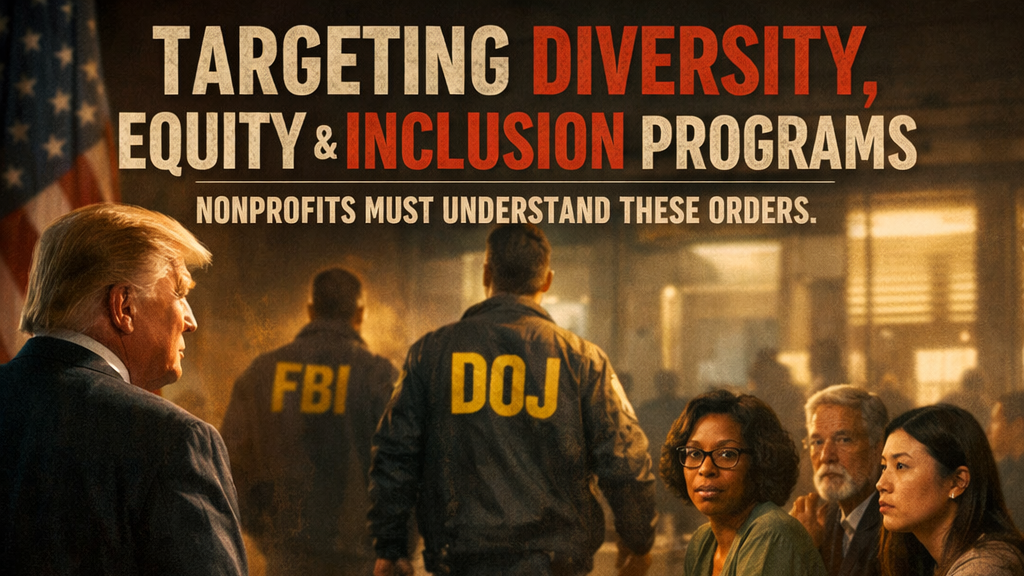
The new Trump administration has issued three significant executive orders targeting diversity, equity, and inclusion (DEI) programs. Nonprofits must understand these orders, the legal challenges they're facing, and the potential implications for organizations that receive federal funding or partner with federal agencies.
The Three Executive Orders
Right out of the gate, the new administration issued several executive orders aimed at terminating DEI programs within the federal government and discouraging DEI initiatives in the private and nonprofit sectors. Understanding each order is critical for nonprofits navigating this new regulatory landscape.
Executive Order 14151 – Rescinding DEI in Federal Government
This executive order takes the most comprehensive approach to eliminating DEI infrastructure within the federal government:
Rescinds all previous DEI-related executive orders issued by prior administrations
Mandates termination of all DEI, DEIA (diversity, equity, inclusion, and accessibility), and "environmental justice" offices and positions within the federal government
Eliminates federal DEI infrastructure and programming across all federal agencies
Directs agencies to cease all DEI-related activities including training, hiring initiatives, and program development
This order fundamentally reshapes how federal agencies approach workforce diversity and inclusion, setting the tone for the administration's broader policy direction.
Executive Order 14173 – DEI Restrictions on Federal Contractors
This order extends DEI restrictions beyond the federal government to private organizations, including nonprofits:
Prohibits private organizations from conducting DEIA employment programs for jobs created by federal contracts
Directs federal departments not to issue contracts to private organizations (including nonprofits) that enforce DEIA frameworks
Creates direct contractual obligations for nonprofits receiving federal funds
Establishes compliance requirements that organizations must meet to maintain federal contracts
This is the order with the most direct impact on nonprofits, as it creates enforceable contractual restrictions on organizations receiving federal funding.
Executive Order 14168 – Sex as Immutable Binary Classification
This order addresses gender identity and biological sex classifications:
Mandates federal agencies to recognize sex as an immutable binary classification (male or female)
Affects how federal agencies implement and interpret policies related to gender identity
Impacts federal programs and services that previously recognized gender identity distinctions
Creates compliance requirements for organizations partnering with federal agencies
This order has particular implications for healthcare organizations, educational institutions, and social services providers that work with transgender and non-binary populations.
Legal Challenges and Court Outcomes
The executive orders are facing multiple legal challenges across federal courts, with outcomes varying significantly by jurisdiction. This creates a complex and uncertain regulatory environment for nonprofits.
Preliminary Injunctions in Some Jurisdictions
Several federal courts have issued preliminary injunctions blocking certain DEI provisions:
Temporary halt to enforcement in specific jurisdictions where injunctions were granted
Geographic variation in enforcement based on court jurisdiction
Ongoing litigation means these injunctions could be lifted or expanded
Organizations in affected jurisdictions face uncertainty about long-term enforcement
These preliminary injunctions provide temporary relief but do not resolve the underlying legal questions about the orders' constitutionality.
Enforcement Allowed in Other Jurisdictions
Conversely, other courts have allowed the administration to proceed with enforcement:
Federal agencies permitted to enforce the orders while litigation continues
Organizations in these jurisdictions must comply with order requirements
Immediate compliance obligations for federal contractors and grantees
Risk of contract termination for non-compliance
This split in court outcomes creates a patchwork enforcement landscape where compliance requirements vary by location.
The Mixed Legal Landscape
The current situation presents significant challenges for national nonprofits:
Jurisdictional uncertainty about which rules apply where
Potential for conflicting obligations if operating in multiple jurisdictions
Ongoing appeals that could change enforcement status
Supreme Court review possible if circuit courts issue conflicting rulings
Organizations must stay informed about developments in their specific jurisdictions and be prepared to adapt quickly as court decisions evolve.
Private Legal Suits Against DEI Initiatives
Beyond government enforcement, a new trend is emerging: private plaintiffs filing lawsuits against organizations with DEI programs.
The American Bar Association Lawsuit
A recent high-profile case illustrates this trend:
Plaintiff sued the American Bar Association over diversity scholarships for law students
Claims the scholarships constitute illegal discrimination based on race
Establishes precedent for challenging DEI initiatives through private litigation
Creates template for similar lawsuits against other organizations
This case demonstrates that nonprofits face legal exposure not just from government enforcement but also from private parties challenging their DEI programs.
Increasing Litigation Risk
The ABA lawsuit is part of a broader pattern:
Multiple organizations facing similar challenges to their DEI programs
Private plaintiffs emboldened by recent Supreme Court decisions on affirmative action
Legal costs mounting even for organizations that successfully defend their programs
Reputational risks from public litigation over DEI initiatives
This trend suggests that visible DEI programs may attract legal challenges regardless of government enforcement actions.
Implications for Nonprofits
Understanding which organizations face the greatest exposure is critical for risk assessment and strategic planning.
Organizations at Highest Risk
Nonprofits receiving federal funding or contracts:
Direct contractual obligations under Executive Order 14173
Risk of contract termination for non-compliance
Potential loss of significant revenue streams
Compliance monitoring and reporting requirements
Organizations partnering with federal agencies:
Indirect pressure to align with federal DEI policies
Risk of partnership termination
Potential exclusion from future federal collaborations
Reputational considerations in federal relationships
Nonprofits with established DEI programs and initiatives:
Increased scrutiny from both government and private plaintiffs
Potential legal challenges to specific program elements
Need to reassess program design and implementation
Documentation and justification requirements
Potential Challenges Organizations Face
Pressure to terminate or modify DEI initiatives:
Federal contractors may face direct requirements to eliminate certain programs
Organizations must balance compliance with mission and values
Staff and stakeholder concerns about program changes
Potential impact on organizational culture and recruitment
Increased scrutiny from government agencies and private plaintiffs:
Enhanced compliance monitoring and audits
Legal discovery requests and document production
Public attention and media coverage
Board and leadership time devoted to legal matters
Legal and compliance costs:
Attorney fees for compliance review and litigation defense
Consultant costs for program redesign
Staff time devoted to compliance activities
Insurance premium increases
Uncertainty about program permissibility:
Lack of clear guidance on what's permitted vs. prohibited
Varying interpretations across jurisdictions
Evolving legal landscape as cases proceed
Difficulty planning long-term program strategies
What Nonprofits Should Do Now
Organizations should take immediate action to assess their exposure and develop response strategies.
Immediate Actions (Next 30 Days)
1. Review your organization's DEI programs and initiatives
Inventory all DEI-related programs, policies, and practices
Identify which programs involve hiring, contracting, or employment
Document the rationale and legal basis for each initiative
Assess which programs might conflict with executive orders
2. Assess which programs involve federal funding or federal contracts
Review all federal grant agreements and contracts
Identify DEI-related requirements or restrictions in agreements
Calculate the financial impact of potential contract loss
Determine which programs are most vulnerable
3. Consult with legal counsel about compliance obligations
Engage attorneys with expertise in nonprofit law and employment law
Request legal analysis of your specific DEI programs
Discuss litigation risk and defense strategies
Develop compliance recommendations
4. Document your current DEI initiatives and policies
Create comprehensive written descriptions of all programs
Gather supporting documentation and legal justifications
Preserve communications about program development and rationale
Prepare for potential legal discovery
5. Board review of DEI exposure and legal risk
Brief board on executive orders and legal challenges
Present risk assessment and potential financial impacts
Discuss organizational values and mission alignment
Obtain board guidance on strategic direction
Short-Term Actions (Next 3-6 Months)
1. Monitor litigation developments in federal courts
Track cases challenging the executive orders
Follow private lawsuits against organizations with DEI programs
Subscribe to legal updates from nonprofit associations
Adjust strategies based on court outcomes
2. Follow IRS enforcement actions and guidance updates
Monitor IRS announcements about tax-exempt status implications
Review any new guidance on permissible DEI activities
Assess whether IRS enforcement priorities are changing
Consult with tax counsel about compliance
3. Review federal contracts for DEIA-related compliance requirements
Examine contract language for DEI restrictions
Identify upcoming contract renewals that may include new requirements
Assess whether contract modifications are needed
Plan for potential contract renegotiation
4. Assess reputational risk from potential private lawsuits
Evaluate public visibility of your DEI programs
Consider stakeholder reactions to program changes
Develop communications strategies for various scenarios
Prepare messaging for donors, staff, and communities
5. Develop contingency plans for program modifications if required
Design alternative approaches to diversity and inclusion goals
Identify which program elements are most legally vulnerable
Create implementation timelines for potential changes
Budget for program redesign and transition costs
Long-Term Actions (6-12 Months)
1. Prepare for potential changes to federal contracting requirements
Build flexibility into program design and implementation
Diversify funding sources to reduce federal dependency
Develop relationships with non-federal funders
Create sustainable programs less dependent on federal support
2. Adjust DEI programs as needed based on court outcomes
Implement changes required by final court decisions
Redesign programs to comply with new legal standards
Communicate changes to stakeholders transparently
Document compliance efforts thoroughly
3. Consider alternative approaches to diversity and inclusion goals
Explore permissible methods for advancing diversity
Focus on programs with strong legal foundations
Emphasize merit-based approaches where appropriate
Maintain commitment to organizational values within legal constraints
4. Build flexibility into governance and program structures
Create adaptable policies that can respond to legal changes
Develop decision-making processes for rapid response
Establish clear authority for program modifications
Build organizational capacity for ongoing compliance
5. Stay informed about ongoing litigation and appeals
Maintain relationships with legal counsel and professional associations
Participate in nonprofit sector advocacy efforts
Share information with peer organizations
Contribute to collective understanding of legal landscape
Key Takeaways
Three executive orders target DEI in federal government and restrict DEIA in federal contracting, with Executive Order 14173 having the most direct impact on nonprofits receiving federal funds
Legal challenges are ongoing with mixed court outcomes — some courts have issued preliminary injunctions while others allow enforcement to continue; these outcomes could significantly affect implementation and create jurisdictional variations
Private lawsuits targeting DEI programs are increasing — the American Bar Association lawsuit over diversity scholarships establishes a precedent for private litigation, creating additional compliance risks beyond government enforcement
Nonprofits with federal contracts should immediately review their DEI programs for potential conflicts with Executive Order 14173 and assess their exposure to contract termination or funding loss
Organizations should stay informed about ongoing litigation and be prepared to adapt programs quickly if court decisions or enforcement priorities change
Consult with legal counsel to assess your organization's specific DEI exposure — each organization's risk profile depends on its specific programs, funding sources, and geographic location
The regulatory landscape remains uncertain — expect continued developments over the next 6-12 months as cases wind through federal courts and potentially reach the Supreme Court
Disclaimer: This guide provides general information about 501(c)(3) status and should not be considered legal or tax advice. Consult qualified professionals regarding your specific situation. 501 Donate connects donors with thoroughly vetted charities and causes that matter. For questions, reach us through our YouTube channel, website, or email—or contact the 501(c)(3) organization directly. Please note that 501 Donate is a for-profit marketing company, not itself a nonprofit or charity, and does not accept donations or gifts of any kind.